

























Powering Change

Installing since 2010 · 0118 951 4490 · info@spiritenergy.co.uk

Our brochures
Request a quote
Which Trusted Trader logo

Solar Panels for Care Homes UK | Spirit Energy

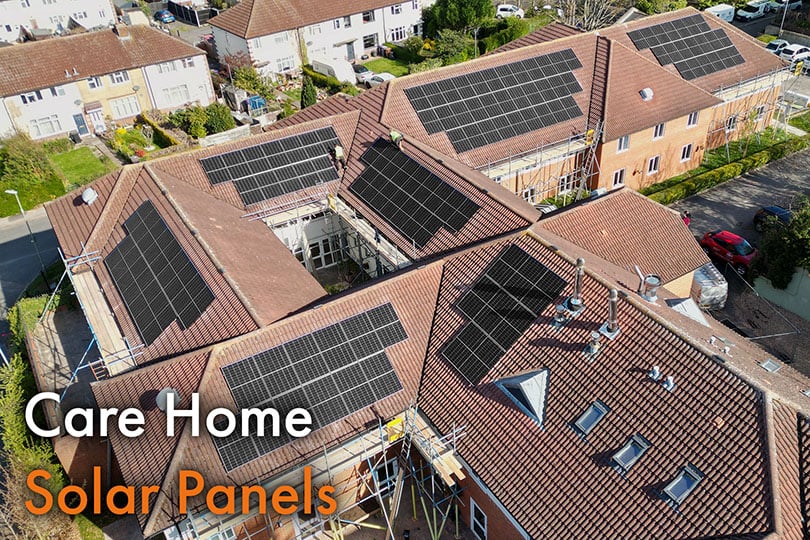
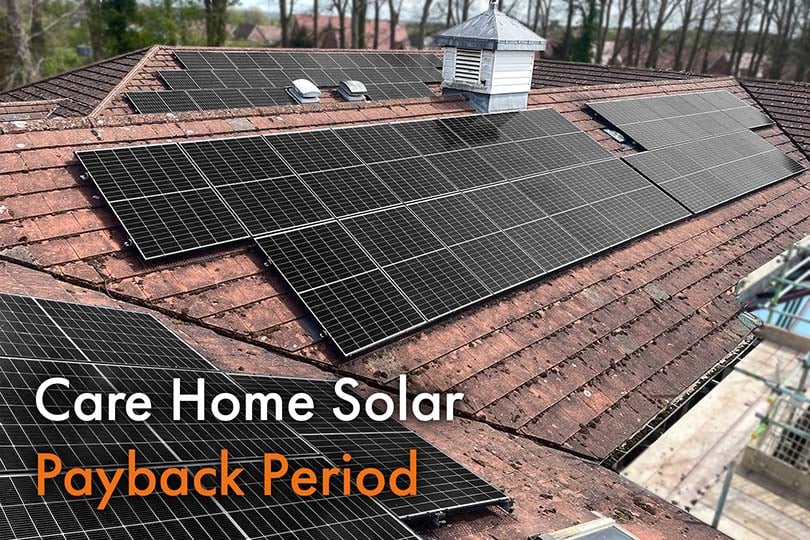
Care home solar panels installed by Spirit Energy for B&M Care Homes, 2025.

Solar Panels for Care Homes: Lower Bills, Proven Returns 

Care homes in the UK spend between £15,000 and £156,000 a year on energy. Spirit Energy installs solar PV for care homes with payback periods of 3–6 years and internal rates of return of up to 30%. We are currently installing solar across a 22-site portfolio with B&M Care Homes, and have previously installed for  St Michael's Hospice and St Peter's Hospice.

Contact Spirit Energy to explore solar panels for your business.

Selling-Points-Spirit-Energy

 Why Do Care Homes Get Such Strong Returns from Solar? 

Care homes run 24 hours a day, 365 days a year. Heating, hot water, laundry, catering, and lighting never stop. That constant daytime load means a care home uses far more of its own solar generation than a typical office building, which sits empty at night.

Most commercial buildings self-consume around 20–30% of the solar electricity they generate. A care home typically self-consumes 40–60%. That difference in self-consumption is the main reason care home solar delivers returns that most commercial properties cannot match.

Energy is one of the largest controllable costs in the care sector. 


Care Home Solar Installed by Spirit Energy for B&M Care Homes, 2025

Should Businesses Invest in Solar? - Spirit Energy YouTube Case Study.

Solar Panels for Care Homes - How Much Can Care Homes Save with Solar?

Solar Panels Installed for St Michael's Hospice, 2024

What is the Payback Period for Care Home Solar?

These figures come from completed Spirit Energy installations, not projections. Learn more about care home ROI.

  System Size Year 1 Saving Payback Period Internal Rate of Return (IRR)
St Leonard's (B&M Care Homes)  70.53 kWp £13,000+ 6 years 21%
St Luke's (B&M Care Homes)  132.9 kWp   £21,000+  6 years 20%
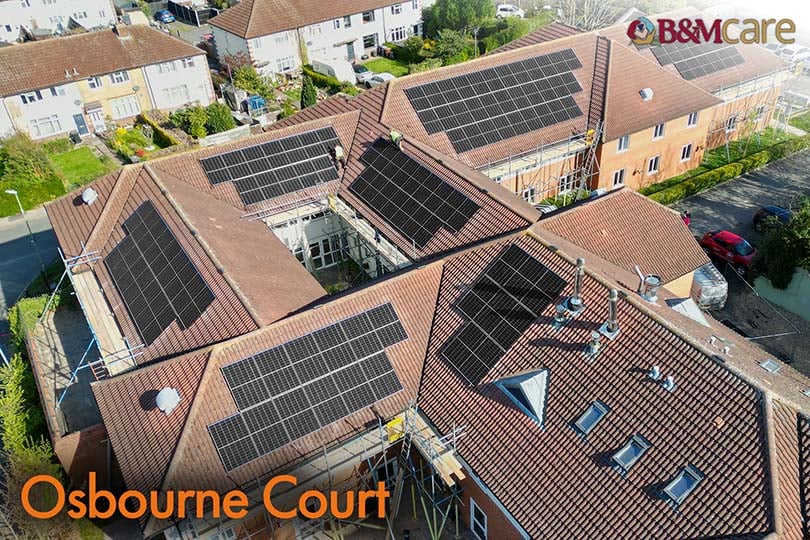
Osbourne Court (B&M Care Homes) 52.65 kWp   £9,266  5 years 24%


 Does Solar Support CQC Ratings or Sustainability Reporting? 

The Care Quality Commission does not score providers on energy use directly, but sustainability is increasingly part of how providers are judged.

More immediately, many care home providers are now required to report on Scope 2 emissions (purchased electricity) under SECR or their own ESG frameworks. On-site solar generation reduces purchased electricity and therefore reduces Scope 2 emissions.

For providers tendering for NHS or local authority contracts, demonstrable sustainability measures are a growing part of the tender scoring criteria across England.

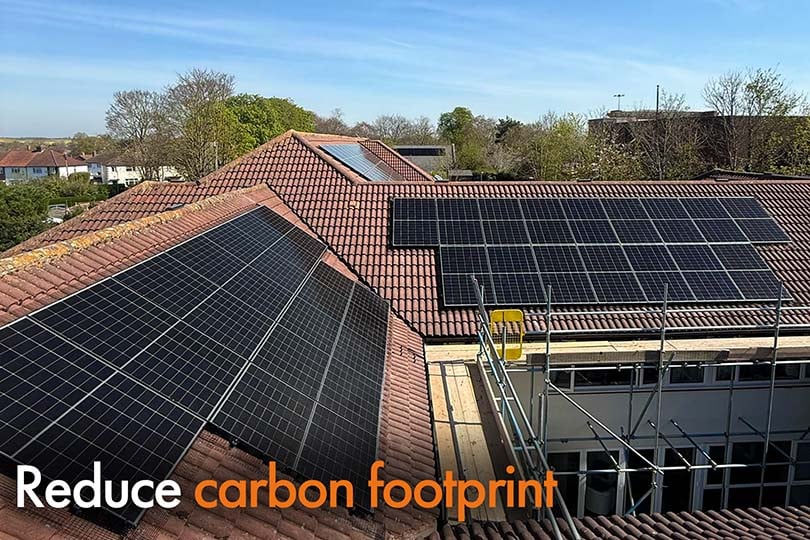
For Osbourne Court, such initiatives can save up to 11,015 kg of CO₂ annually, equivalent to planting 500 trees each year.

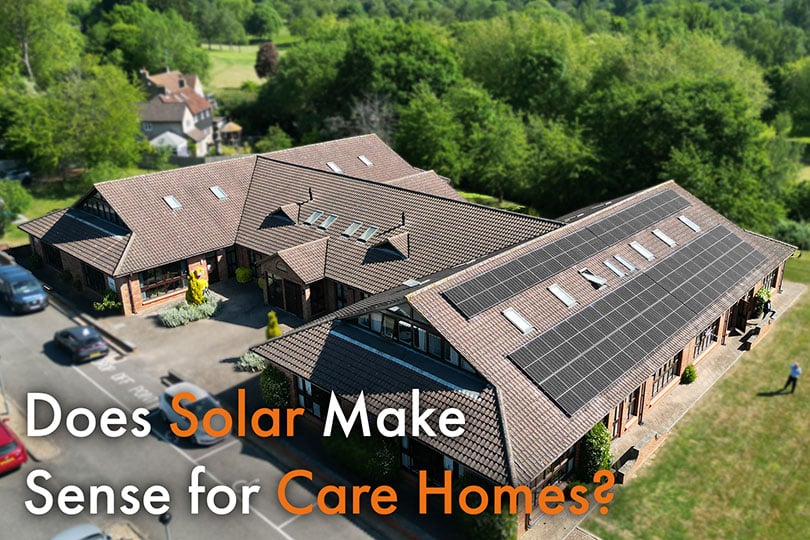
Installed by Spirit Energy, 2025

Solar PV offers a wide range of benefits for care homes, both financially and operationally:

  • Very cost-effective – Installing solar panels can significantly reduce electricity bills, with savings starting from day one. Systems typically achieve a strong payback period, providing long-term financial security for the care home.

  • Ideal for high energy demand – Care homes operate around the clock, with heating, lighting, catering and medical equipment all driving usage. Solar PV helps offset this demand by generating clean power on-site, reducing reliance on the grid.

  • Low maintenance – Once installed, solar systems require minimal upkeep. Routine cleaning and inspections are straightforward, especially with professional support.

  • Stronger winter performance with batteries – When combined with battery storage, solar can supply evening and overnight demand, helping care homes make the most of generation even in winter when sunlight hours are shorter.

  • Improved resilience – With battery backup, care homes can maintain critical services during grid outages, providing additional reassurance for staff and residents.

  • Environmental benefits – Solar PV reduces carbon emissions and helps care homes demonstrate a clear commitment to sustainability, something increasingly valued by residents, families and regulators.

  • Future-proofing – Systems can be designed with expansion in mind, allowing care homes to increase capacity as demand grows or as budgets allow.

For care homes, solar PV is not only a way to cut costs but also a long-term investment in resilience and sustainability.
While solar PV has many advantages, there are some considerations that care homes should be aware of before committing to an installation:

  • Upfront investment – The initial cost of installing solar panels and (if required) battery storage can be significant. Although systems usually deliver strong payback, it still requires capital or financing.

  • Roof suitability – Not all care home buildings have roofs that are ideal for solar. Shading, orientation, roof condition and available space can all affect system size and output.

  • Variable generation – Solar panels only generate when the sun is shining, so output is lower in winter or during poor weather. Pairing with battery storage helps, but grid electricity will still be needed.

  • Aesthetic and planning considerations – In some cases, planning permission may be needed, particularly for listed buildings or sites in conservation areas. The visual impact of panels may also need to be considered.

  • Maintenance access – While panels are generally low-maintenance, care homes must ensure safe access for cleaning and occasional servicing, which can be more complex on large or tall buildings.

  • Grid connection limits – In some areas, local grid capacity may restrict the size of system that can be connected without additional upgrades or approvals.

Despite these challenges, most care homes find that the long-term financial and environmental benefits of solar outweigh the drawbacks, especially when systems are carefully designed to match the site’s needs.

Savings come from using your own solar power instead of buying from the grid, plus income from exporting surplus. As a guide, a 50 kWp system in the south of the UK might generate about 45,000 kWh a year. If a care home self-consumes 50 to 70 percent at an import rate of 20 to 30 p/kWh, that is roughly £4,500 to £9,500 off the bill each year, plus export income. Actual results depend on load profile, tariffs, system size, and shading.

Usually no. Roof-mounted solar on non-domestic buildings is generally permitted development if panels sit no more than 200 mm from the roof surface, do not exceed the roof ridge height, and are sited to minimise visual impact. Permission is likely needed if your care home is a listed building, in a conservation area, has wall-mounted arrays on principal elevations, or features prominent A-frame systems on flat roofs. The care home will also still need structural sign-off and DNO approval.

Solar PV installation time for care homes varies based on system size and roof layout, typically taking one to two weeks from scaffolding to commissioning with minimal disruption to daily operations. Note that applications to the Distribution Network Operator (DNO) and other necessary paperwork must be completed beforehand, extending the overall project timeline.

Installing solar panels on care homes is not a disruptive process, and Spirit Energy regularly works outside of regular hours to ensure that our works are not disruptive to the day to day operations of the care home.

 How Much Do Care Homes Spend on Energy, and How Is Solar Funded? 

A small care home spends £14,400 to £27,600 a year on energy. A medium home pays up to £71,400. Large nursing or dementia facilities can exceed £156,000. UK business electricity prices are 118% above the European median and rose 113% in real terms between 2019 and 2024. Solar typically offsets 30 to 50% of a care home's daytime consumption.

You do not need capital reserves to install solar. Spirit Energy offers three financing routes: Power Purchase Agreement, Hire Purchase, and Capex.

 Read the full breakdown of solar financing options

Installed by Spirit Energy, 2025


Installed by Spirit Energy, 2025

Solar Installation Video

Spirit Energy will be publishing a series of case studies showcasing our collaboration with the B&M Care Homes group.
 
The case study series will document how the portfolio-wide solar installations are helping to reduce energy costs, cut carbon emissions and support the group’s wider sustainability goals.
 
Each case study will highlight a different care home, providing insight into solar system design, care home solar installation, and the financial and environmental benefits achieved by installing solar panels on care homes.

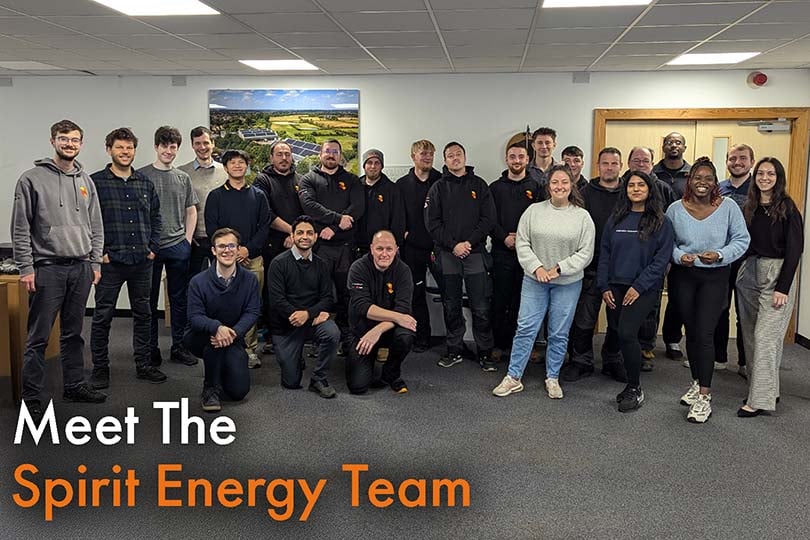
Why Spirit Energy?

Spirit Energy has 16 years in the solar and battery sector and over 6,000 installations across the UK. We are a Which? Trusted Trader, a Tesla Premium Installer, MCS certified, and hold the HCS Safety Award.

We design and install in-house. That matters for care homes because it means one point of accountability from survey to commissioning to aftercare.

Our current care home client base includes B&M Care Homes
(23-site portfolio), St Michael's Hospice, and St Peter's Hospice.

Lower bills. Clean energy you own. For decades.

Vishal Giga
Operations Director

Joined Spirit in 2010

Vishal joined Spirit Energy a few months after Erica and Ian founded the business in 2010 as a project manager, and is now our Operations Director. All of our project managers and installers are in-house, and Vishal oversees them all and is in charge of making sure that every project goes smoothly and is installed on time. Vish has a wealth of experience with both commercial and residential projects, and directly manages every commercial project that we do, including our installations at Philip Dennis Foodservice in April 2024, and Hansgrohe's headquarters in September 2024.

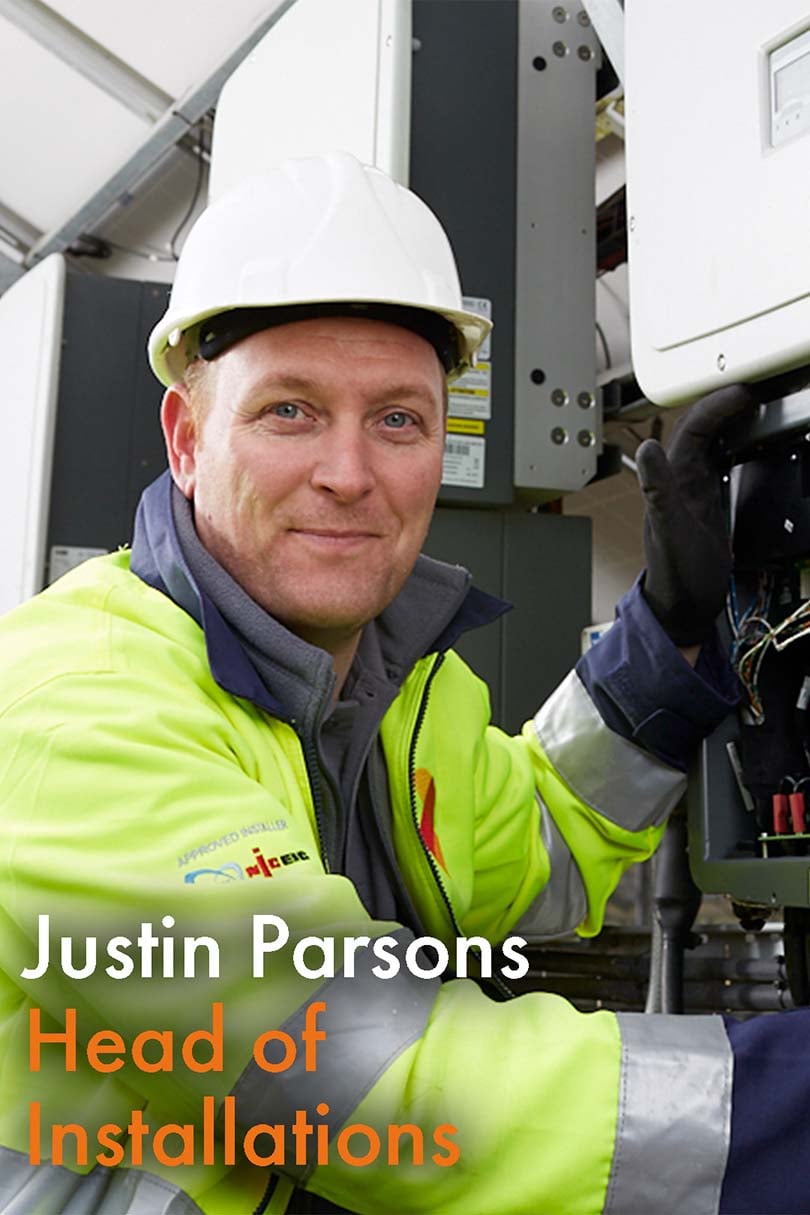
Justin Parsons
Head of Installations

Joined Spirit in 2010

Justin is the backbone of the company and part of the leadership team. He has overall responsibility for the installers, electrical design and sign off of all systems as well doing a technical and structural survey for every project to ensure we can manage each job perfectly. His devotion and meticulous attention to detail has helped build Spirit into the reputable and trustworthy brand we are today. 

You will most likely meet Justin on your technical & structural survey where he will plan your entire installation and run you through every minute detail. 

"My ultimate goal is to ensure our operations run smoothly, delivering exceptional customer service and top-quality installations to every customer, domestic or commercial."

-Vishal Giga, Operations Director

"I know that the technical & structural survey is a step that other installers don't feel is necessary, but many of Spirit's customers appreciate the chance to talk to the actual installers before the installation date."

-Justin Parsons, Head of Installations

{{ footer_js() }} {{ js_integration_body_end() }}