
Powering Change
Installing since 2010 · 0118 951 4490 · info@spiritenergy.co.uk


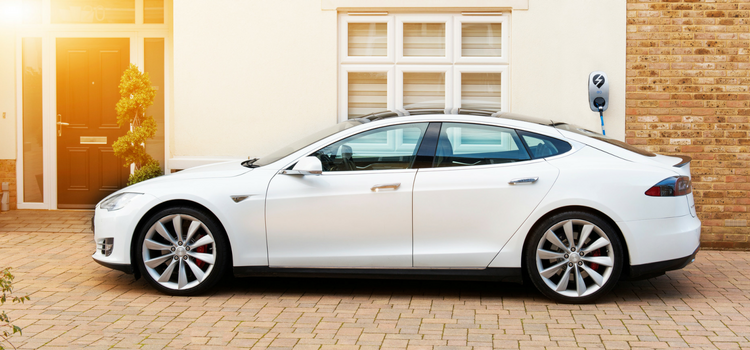
You charge an electric car by plugging it into a dedicated socket called an EV chargepoint. The type of charger and cable you need depends on your vehicle and the type of inlet socket it has. There can be a lot of jargon involved, so this page breaks down the key terms as clearly as possible.
There are three main parameters associated with EV chargepoints:
The rated power of a chargepoint is determined by the charge current (Amps) and the voltage. The current may be AC (alternating current) or DC (direct current).
The limiting factor in rated power is usually the grid connection. With a standard domestic single-phase (230V) supply, the maximum AC charging rate achievable is 7.4kW. With a standard commercial three-phase connection, AC charging is limited to 22kW. Greater charging power, from 50kW up to 350kW or more, is achieved with rapid DC chargers found on public charging networks.
Most current EV models have a battery of between 50 kWh and 100 kWh. As a rough guide, 100 miles of range typically requires around 25–30 kWh.
| Supply type / charger rating | AC/DC | Rated power* | Time to charge 30kWh | Time to charge 75kWh | |
| Regular electricity socket 13A | Slow | AC | 3.0 kW | 10 hours | 25 hours |
| Single phase 16A | Slow | AC | 3.7 kW | 8 hours | 20 hours |
| Single phase 32A | Fast | AC | 7.4 kW | 4 hours | 10 hours |
| 3 phase, 16A per phase | Fast | AC | 11 kW | 2 hours 45 mins | 6 hours 52 mins |
| 3 phase, 32A per phase | Fast | AC | 22 kW | 1 hour 22 mins | 3 hours 25 mins |
| DC Rapid | Rapid | DC | 50-150 kW | 36 - 12 mins | 1.5 - 0.5 hours |
| DC ultra-rapid | Ultra-rapid | DC | 150-350 kW | 12 - 5 mins | 30 - 12 mins |
*Simplistically (ignoring Power Factor correction):
Electric vehicles connect to the chargepoint via a cable fitted with connectors, one fitting the car's inlet socket and one fitting the charger outlet. Cables may be detachable at both ends, or one end may be permanently tethered to the charging unit.
Tethered vs untethered: which should you choose?
A tethered charger has a cable permanently attached, so you simply uncoil a
nd plug in without carrying your own cable. An untethered (universal socket) charger has no attached cable, you supply your own.
We have historically recommended universal socket chargers for the flexibility they offer if you change vehicles. However, tethered chargers have become significantly more popular due to their convenience, and since virtually all modern EVs use a Type 2 inlet for AC charging, compatibility is rarely an issue. Either option works well for most customers.
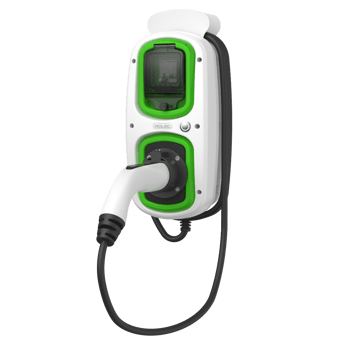
Alternatively, one end of the cable may be permanently 'tethered' to a charging unit. The options are illustrated by the Rolec WallPod offering. The first image shows a unit with a tethered cable. The second shows a unit with a 'universal' Type 2 socket:
 |
 |
Type 2 (Mennekes) connectors are the standard for EVs in the UK and Europe for home and public AC charging. They have a seven-pin connector and support power levels from 3.7kW up to 22kW.
CCS (Combined Charging System) connectors are the standard for rapid DC charging in the UK and Europe. They look similar to the Type 2 connector but have two additional DC pins, and support rapid and ultra-rapid charging from 25kW up to 400kW+. If your EV was registered after 2018, it almost certainly has a Type 2 inlet for AC charging and a CCS port for DC rapid charging.
CHAdeMO is a DC rapid charging standard primarily found on older Nissan Leaf models and some early Japanese EVs. It is now a declining standard in the UK and Europe, CHAdeMO represents less than 30% of connectors across European charging networks and less than 15% of newly installed fast chargers. If you have a CHAdeMO vehicle, chargers remain available but provision will not grow.
Tesla vehicles in the UK use a Type 2 inlet for AC charging, exactly the same as other European EVs, and CCS for DC rapid charging. All Tesla Supercharger sites in the UK are CCS-compatible, meaning non-Tesla EVs with CCS can use them, and Tesla drivers can use the wider CCS rapid network.
The connector protocols and achievable charge rates are summarised below:
| Protocol | AC / DC | Single phase/ 3 phase | Charger rating achievable | Use |
| UK 3-pin (BS 1363) | AC | Single phase | Up to 3 kW | Emergency/occasional only |
| Type 1 American (J1772) | AC | Single phase | 3-7 kW | Older EVs (e.g. early Nissan Leaf) |
| Type 2 European (Mennekes, IEC 62196) | AC | Single phase and 3 phase | 3-22 kW | Standard for all modern UK/EU EVs |
| CCS (Combined Charging System) | DC | - | 25-400 kW+ | Standard rapid/ultra-rapid DC charging |
| CHAdeMO | DC | - | 25-100 kW | Legacy: older Nissan/Mitsubishi models only |
| Commando (IEC 60309) | AC | - | 3-22 kW | Commercial/industrial |
Domestic
We always recommend installing a minimum 7kW (32A) fast chargepoint at home, even if your current vehicle only accepts a slower charge rate. The vehicle has an onboard charge controller and will only draw what it can accept, but installing 7kW now future-proofs the installation for your next vehicle.
Our current domestic charger recommendations are:
Choosing the right charger depends on your situation — compatibility with other parts of your system, aesthetics, and budget are all relevant factors. Please request a quote or call us on 0118 951 4490 to discuss.
Commercial: workplace or public charging
Chargepoints installed in workplaces or public spaces should ideally include:
Additional useful options depending on application include pole mounting, personal charging cards, key fobs or booking systems, configurable pricing and charging windows, prepayment, custom branding, load management to avoid breaching the grid import limit, and vandal-proofing.
Slow charging uses a single-phase 13A or 16A connection (up to 3.7kW). A 13A adapter plugging into a standard socket operates at around 11A. Suitable for overnight charging of smaller batteries or as an emergency backup.
Fast charging covers 7–22kW. Most domestic wall boxes, workplace chargers, and on-street chargers operate in this range. A 7kW charger will fully recharge most EVs overnight. Not all vehicles can accept 22kW AC, the car's onboard charger will regulate the draw to its maximum capability regardless.
Rapid charging operates at 50–150kW DC and can charge most cars to around 80% in 20–40 minutes. Found at motorway services and dedicated charging hubs.
Ultra-rapid charging operates at 150kW and above, some stations now exceed 350kW, though only certain high-specification vehicles (typically with 800V battery architecture) can accept the highest rates. Regular use of rapid and ultra-rapid charging can reduce battery longevity over time, so it is generally recommended to rely on home charging for day-to-day use and reserve rapid charging for longer journeys.
Mode 1: household socket and extension lead. The vehicle connects to the grid via a standard 3-pin socket. Maximum delivery is limited to 11A to reduce overloading risk. Not recommended for regular use, the sustained high draw over several hours increases wear on the socket and raises the risk of overheating or fire, particularly if the electrical installation is not fully up to current regulations.
Mode 2: non-dedicated socket with cable-incorporated protection device. The vehicle connects via a household socket but uses a cable with a built-in protection device (often called a granny charger or EVSE cable). More expensive than Mode 1 but safer. Suitable as a backup option, not for regular daily charging.
Mode 3: fixed, dedicated circuit and socket. The vehicle connects directly to the electrical network via a dedicated circuit with a specific socket and plug, and a permanently installed control and protection function. This is the only charging mode that fully meets applicable standards for electrical installations, and is the setup used by all domestic and commercial wall-mounted chargepoints. It also allows load management so that other household appliances can operate simultaneously during charging.
Mode 4: DC connection. The vehicle connects to the grid through an external DC charger. Control, protection functions, and the vehicle charging cable are all permanently installed in the unit. This is the setup used by rapid and ultra-rapid public chargers.
Connection cases:
For even more information, download our free guide to domestic EV charging: