
Powering Change
Installing since 2010 · 0118 951 4490 · info@spiritenergy.co.uk


The applications of commercial storage are covered in detail on this page. In summary they are as follows:
| Application | |
| Increased on-site use of solar power / micro-generation | Store surplus solar for use in the evenings or at weekends, maximising self-consumption |
| Reduce peak demand chargers - 'buy cheap, use peak' | Reduce DUoS red band charges by discharging during peak periods (typically 4:30–7:30pm weekdays) |
| Earn grid income | Capacity Market, Dynamic Containment, Quick Reserve, Firm Frequency Response |
| Overcome grid constraints | Trickle-charge a battery from a limited connection, then fast-discharge for high-demand applications such as EV charging |
| Commercial UPS battery backup (in a power cut) | Emergency power for lighting, critical loads, or whole-site backup |
| Off-grid | Combined with solar and/or a generator for fully independent power |
| Reduce carbon footprint | Reduce line losses, store renewable generation for use at peak demand periods |
All commercial battery storage systems consist of three main components:
Most of the system cost is attributable to the battery itself. Most of the functionality, backup capability, peak demand avoidance, solar self-consumption, is determined by the inverter/charger and BMS.
Systems can either be assembled from individual components (separate battery, inverter, and BMS from different manufacturers) or purchased as an integrated package, where the battery and inverter are combined into a single unit or containerised enclosure. For commercial and industrial scale, containerised systems are increasingly common, offering factory-tested, plug-and-play deployment.
Key design considerations:
A system can either be assembled from individual components, combining for example a Samsung battery with an ABB converter (inverter / charger), or it can be purchased as a 'package' in which the battery and inverter / charger are packaged by the manufacturer, often into a single unit (e.g. Tesla Powerpack) or container (e.g. Sungrow-Samsung).
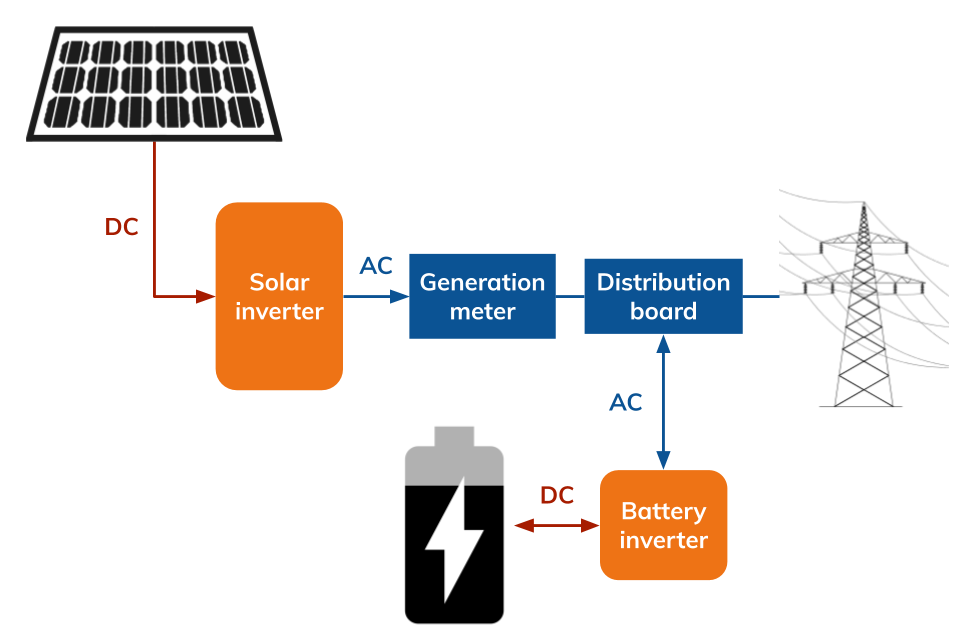
Most systems are 'AC-coupled' i.e. connected to the AC wiring, either at low voltage or at high voltage. The system may or may not include solar panels:
The commercial battery market has consolidated significantly in recent years. Lithium iron phosphate (LFP) has become the dominant technology for stationary energy storage applications, displacing older lithium nickel manganese cobalt (NCM) chemistries that were prevalent five years ago. For longer-duration applications, flow batteries, particularly vanadium redox, remain relevant at utility scale.
The table below summarises the main chemistries relevant to commercial storage in 2026:
| Chemistry | Cycle life | Safety | Best suited to | Key considerations |
| LFP (lithium iron phosphate) | 6,000 - 10,000+ cycles | Excellent - no thermal runaway risk, no cobalt | Most commercial applications - fast response, daily cycling | Now the market standard; best cost/performance balance |
| NCM (lithium nickel cobalt manganese) | 3,000 - 5,000 cycles | Good, but higher thermal runaway risk than LFP | High energy density applications | Being phased out in favour of LFP for stationary storage |
| Vanadium redox flow | 10,000+ cycles | Excellent - non-flammable aqueous electrolyte | Long-duration storage (4+ hours), utility scale | Higher upfront cost; electrolyte retains value at end of life |
| Zinc-based (zinc-bromine, zinc-air) | 5,000+ cycles | Excellent - non-hazardous electrolyte | Long-duration, cost-sensitive applications | Emerging technology; fewer commercial deployments to date |
LFP is now our default recommendation for commercial projects in the size ranges we work with. LFP offers superior thermal stability, longer cycle life, and better cost-performance alignment compared to NCM, and contains no cobalt, removing the ethical and reputational concerns associated with cobalt mining that affected earlier lithium chemistries.
The commercial battery storage market has consolidated around a smaller number of large, well-capitalised manufacturers. The most relevant for UK commercial projects are:
Battery manufacturers:
System integrators (battery + inverter + EMS as a complete package):
Inverter / charger manufacturers for assembled systems:
For most commercial projects, the right system design depends on the primary use case:
Solar self-consumption: size the battery to absorb the typical daily surplus generation, with enough capacity to shift that energy to the evening peak. Oversizing the battery relative to the solar system increases cost without proportional benefit.
Demand management: size the system to cover peak demand periods (typically 4:30–7:30pm weekdays) at the required discharge rate. The key metric here is power (kW) as much as capacity (kWh).
Grid services: systems participating in Capacity Market, Dynamic Containment, or Firm Frequency Response need to be sized and configured to meet the specific response time and duration requirements of each service. Most businesses will access these via an Aggregator rather than directly.
UPS / backup: identify the critical loads, calculate their consumption over the required backup duration, and size the battery accordingly. Response time requirements will also influence inverter choice.
Systems sized between 200kWh and 5MWh are well suited to medium and large commercial and light industrial facilities. A typical 2MW/4MWh system provides two hours at full power, suitable for production support and two-hour flexibility services.